Energy label for an apartment
Energy label for an apartment: your own home, inside a shared building
Your apartment gets its own label, based on its own position in the building. Shared building parts and installations play a large role, so we help you gather the right documents from your owners’ association before the visit.
- Studio, apartment or maisonette up to 50 m² at the lowest rate
- VvE documents counted where they apply
- Selling or letting, arranged in English
From € 220 incl. VATStudio, apartment or maisonette up to 50 m². Larger apartments: see the size bands below.
Updated on · Prices include VAT
The short answer
An energy label for an apartment costs from € 220 including VAT for an apartment, studio or maisonette up to 50 m²; larger apartments follow the size bands below. Your apartment is assessed as an individual home: the walls, floors and ceilings that border outside air or unheated spaces, your windows and the installations that serve your home. Because the roof, the facades and sometimes the heating belong to the owners’ association (VvE), the association’s documents often decide how accurately the label reflects your apartment. You need a valid, registered label when you sell or let it.
How the label is determined
What decides the energy label of an apartment?
Two apartments of the same size in the same building can end up with different labels. The assessor first establishes which building parts form the thermal boundary of your home, and that depends on where the apartment sits in the building. The name of the building type is never enough to assume technical features: the actual situation decides.
Position in the building
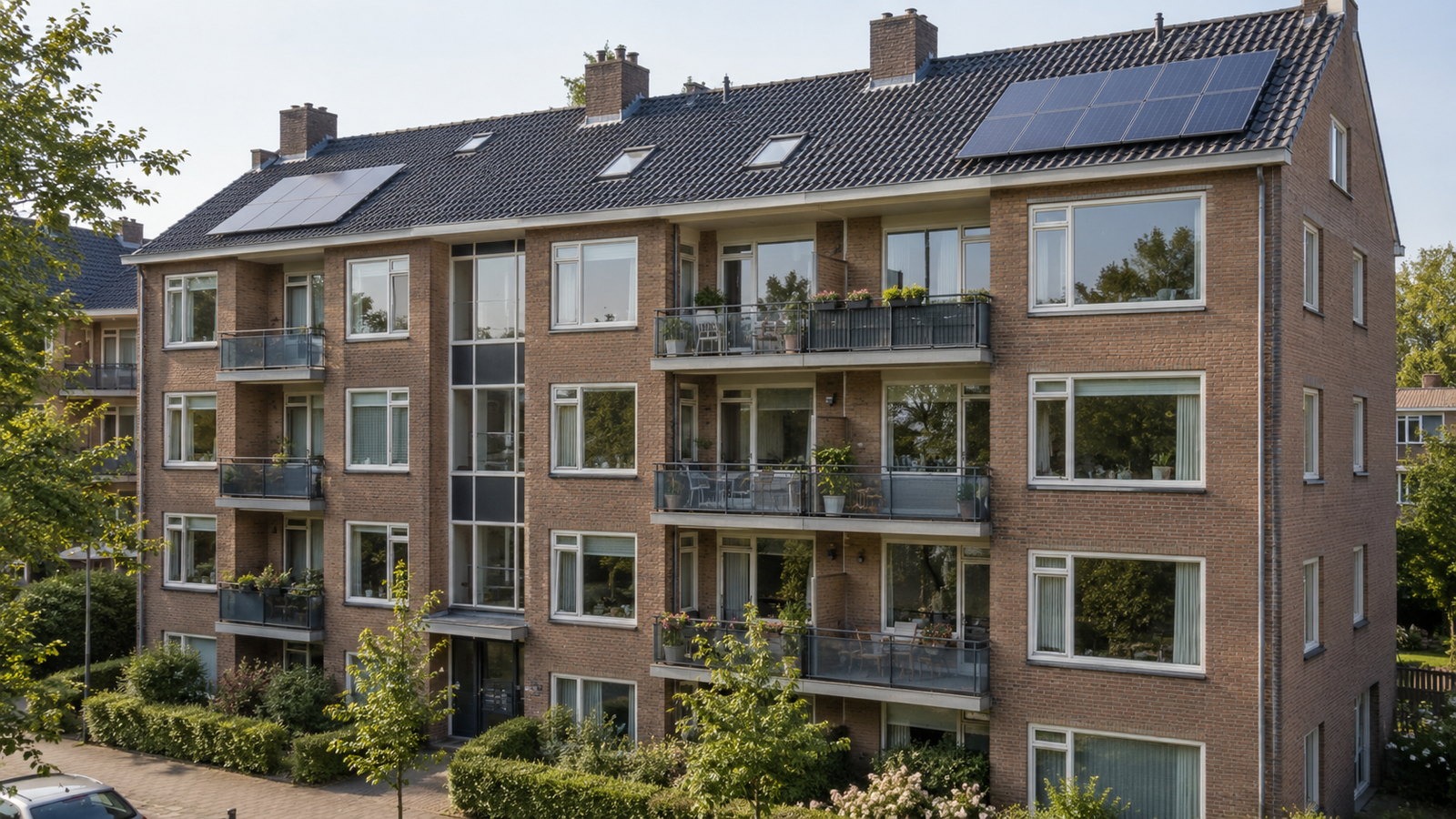
A top-floor apartment is affected strongly by the roof construction above it. A ground-floor apartment is affected by the floor and any crawl space or storage rooms underneath. A corner apartment has more facade exposed to outside air than one in the middle of the block, and an apartment above an open parking level or an unheated space loses heat through its floor. A middle apartment usually has the least external surface, but that alone does not decide the class.
Walls and floors between homes
A wall or floor between two heated homes is treated differently from a facade to outside air or a floor above an unheated storage level. That is why the assessor does not simply count every wall: the real boundary of your apartment is recorded.
Glazing, frames and ventilation
Windows, balcony doors and the front door are recorded with their glazing, frames and sizes. In an older block some owners may have replaced their frames while others still have the originals, so you cannot rely on what the neighbours have. Ventilation, whether natural, mechanical extraction or a unit with heat recovery, is recorded as far as it serves your apartment.
Shared and private parts
Who usually holds the documents for each part of your apartment?
Much of what determines the result is owned collectively. This overview helps you see where to look before the visit.
| Building part | Where the documents usually are | What helps the assessment |
|---|---|---|
| Roof (top-floor apartment) | With the VvE or its managing agent | Invoices, specifications or photos of roof insulation, showing which part of the roof was done |
| Facades and cavity walls | With the VvE | Documentation of cavity wall or facade insulation, with the year and the facades it covered |
| Ground floor, crawl space or storage level | With the VvE | Records of floor insulation, and access to the storage level or crawl space where that is safe |
| Window frames and glazing | With the VvE or with you, depending on the building | Product data or invoices that can be linked to your own windows |
| Collective heating or hot water | With the VvE or the heat supplier | Technical details of the central system or of the heat network connection |
| Your own boiler, heat pump or ventilation unit | With you as the owner | An accessible type plate, manuals or installation documents |
| Solar panels | With you or the VvE | Data showing which panels serve your apartment |
The split between private and shared parts differs per building. Division drawings (splitsingstekeningen) of the building are useful evidence of what belongs to your apartment.
What does it cost?
What does an energy label for an apartment cost?
Apartments, studios and maisonettes up to 50 m² have our lowest rate. Letting the apartment? The WWS points assessment, on its own or combined with a new label, is shown alongside.
You have a valid energy label
WWS points assessment (no visit)
All WWS points and the maximum legal rent, based on your floor plan, photos and WOZ assessment.
- No visit to the property
- Full points assessment
- Maximum rent and rental sector
| Homes up to 100 m² | € 125 |
| 101 to 200 m² | € 150 |
| Above 200 m² | on request |
For a home with a valid energy label.
See my total price →You need the label for your apartment
Energy label for your home
An official energy label (energy performance certificate), registered in EP-Online and valid for ten years from the inspection date.
- Inspection at your property by a certified assessor
- Calculation under NTA 8800 and registration in EP-Online
- Valid for ten years
| Studio, apartment or maisonette up to 50 m² | € 220 |
| Up to 100 m² | € 265 |
| 101 to 150 m² | € 295 |
| 151 to 200 m² | € 325 |
| Above 200 m² | on request |
Outside North and South Holland a regional surcharge of 20% applies, on the Wadden Islands 30%. You see your exact price straight after entering your address.
See my total price →There is no valid label yet
Energy label + WWS points assessment
An official energy label and a WWS points assessment, so you know the maximum rent before you sign a lease.
- Official energy label
- WWS points assessment of the current situation
- One inspection
| Homes up to 50 m² | € 345 |
| 51 to 100 m² | € 390 |
| 101 to 150 m² | € 445 |
| 151 to 200 m² | € 475 |
| Above 200 m² | on request |
One fixed price across the Netherlands.
See my total price →The energy label can be requested online straight away: you see your total price after entering your address. The WWS products can be requested online in the same way.
Owners’ association
The owners’ association (VvE) and shared installations
In the Netherlands the roof, the facades and the structure of an apartment building are managed by an owners’ association, the vereniging van eigenaren or VvE. If the association has insulated the roof, filled the cavity walls or replaced the communal heating, the documentation usually sits with the association or its managing agent rather than with you.
Asking your VvE for those documents before the visit is the single most useful thing you can do for the result. Useful records include renovation reports, invoices and photos of insulation work, specifications of frames and glass, and documentation of collective heating or ventilation systems. A decision in the minutes of a meeting or a long-term maintenance plan is not always enough on its own: it has to be clear that the measure was actually carried out, how, and on which parts of the building.
Communal heating, district heating and hot water
Where the building is connected to a heat network, there is no boiler in your apartment to record. The assessor notes the delivery set instead and works with the data of the network your building is connected to. For a collective boiler or central hot water system, details of the central system, the distribution and the facilities in the building may be needed from the association. Not sure what you have? The assessor establishes it in the home.
Access to shared spaces
Sometimes the assessor needs to see a stairwell, storage level or plant room to understand the boundary of your apartment or a collective installation. We agree that with you in advance, so you can arrange a key or ask the managing agent.
At the inspection
What the assessor looks at in your apartment
Boundaries and floor area
The usable floor area is measured and every boundary is recorded: to outside air, to neighbouring homes, to the stairwell and to unheated spaces.
Windows and doors
Type of glazing, frames and sizes of all windows, balcony doors, roof lights and the front door.
Installations
Heating, hot water, ventilation, cooling and any solar panels, as far as they serve your apartment.
Your documents
Whether the documents you or the VvE supply really relate to this apartment and to these building parts.
Selling and letting
Do you need an energy label to sell or let an apartment?
Yes, in most cases. When you sell, the buyer must receive a valid label registered in EP-Online, at the latest at the transfer at the notary, and the label class must be stated in the advertisement. When you let, the tenant receives the label when the tenancy starts. A label is valid for ten years, and it does not change automatically when you or the VvE improve the building afterwards. See selling your home.
Letting an apartment: the label and the WWS
For a self-contained rental apartment the energy label counts in the WWS points system (woningwaarderingsstelsel), which sets the maximum legal rent in the regulated segments. The Huurcommissie distinguishes between single-family homes and multi-family homes such as apartments when it awards points for the label. Two things regularly catch landlords out: a simplified label (vereenvoudigd energielabel) from 2015 to 2021 gives no WWS points, and a label for the whole complex does not count for the rent, because the Huurcommissie wants a label that belongs to the individual home. Read more about the WWS points assessment and letting with an energy label.
After the VvE has improved the building
A new label is not compulsory just because the association has insulated the building. The existing label can stay valid. A new inspection is worthwhile when you want the current situation officially recorded, for example before a sale or a new tenancy. See a new label after improvements.
Preparation
How to prepare your apartment for the visit
- Ask the VvE early. Requesting documents from the association or its managing agent usually takes the longest, so start as soon as the appointment is agreed.
- Clear the way. Make every room accessible, as well as the meter cupboard, the boiler or delivery set, the ventilation unit and any technical cupboards.
- Collect your own records. Invoices for new glazing, a new boiler or a ventilation unit you installed yourself also count.
- Know that hidden insulation needs proof. Insulation that cannot be seen is only counted with sufficient evidence; otherwise prescribed default values apply.
A full checklist is on our page about documents to prepare, and what happens during the inspection explains the visit itself. All our services for homes are listed on the services overview.
- 1,150+ homes assessed
- Certified energy performance adviser
- Registered under BRL 9500
- Questions handled in English
Everything for your listing
The energy label with measurement report combines both in one visit, with the floor plans included free, all from one visit.
Selling with an energy label →Label and maximum rent together
With the energy label and WWS points assessment you know the maximum legal rent before you sign a lease.
Letting with an energy label →Frequently asked questions
What our clients ask us
Does every apartment in the same building have the same label?
No. Position in the building, floor area, windows, renovations and individual installations can differ per apartment, and each one is assessed on its own.
What does an energy label for an apartment cost?
from € 220 including VAT for an apartment, studio or maisonette up to 50 m², and € 265 up to 100 m². Larger apartments follow the size bands in the price card. Outside North and South Holland a regional surcharge of 20% applies, on the Wadden Islands 30%.
What do you need from my owners’ association?
Any documentation the VvE holds about insulation of the roof, facades or floors and about shared installations. Without it, cautious default assumptions apply to those parts.
Can I use a label for the whole building?
Not for the rent: the Huurcommissie wants a label that belongs to the individual home. If you want certainty when selling or letting, have your own apartment assessed.
Is a new label required after the VvE has insulated the building?
Not automatically. The existing label can remain valid, but a new inspection can be worthwhile to record the current situation, for example before a sale.
Do I need to be there during the visit?
No. A tenant, your estate agent, a family member or another contact person can let the assessor in, as long as this is agreed in advance.
About this page
Written and checked by Energie Prestatie Label A+ in Alkmaar, certified under BRL 9500-W (energy labels for homes) and BRL 9500-MWA-W (tailored advice for homes), Chamber of Commerce 67469612. Prices come from our current rates and include 21% VAT. More about us.
Last updated:
Official sources (in Dutch)
Energy label for your apartment from € 220
Your apartment, assessed on its own merits, with your VvE documents counted.
Prefer e-mail? Write to info@energieprestatielabel.eu. We reply in English.